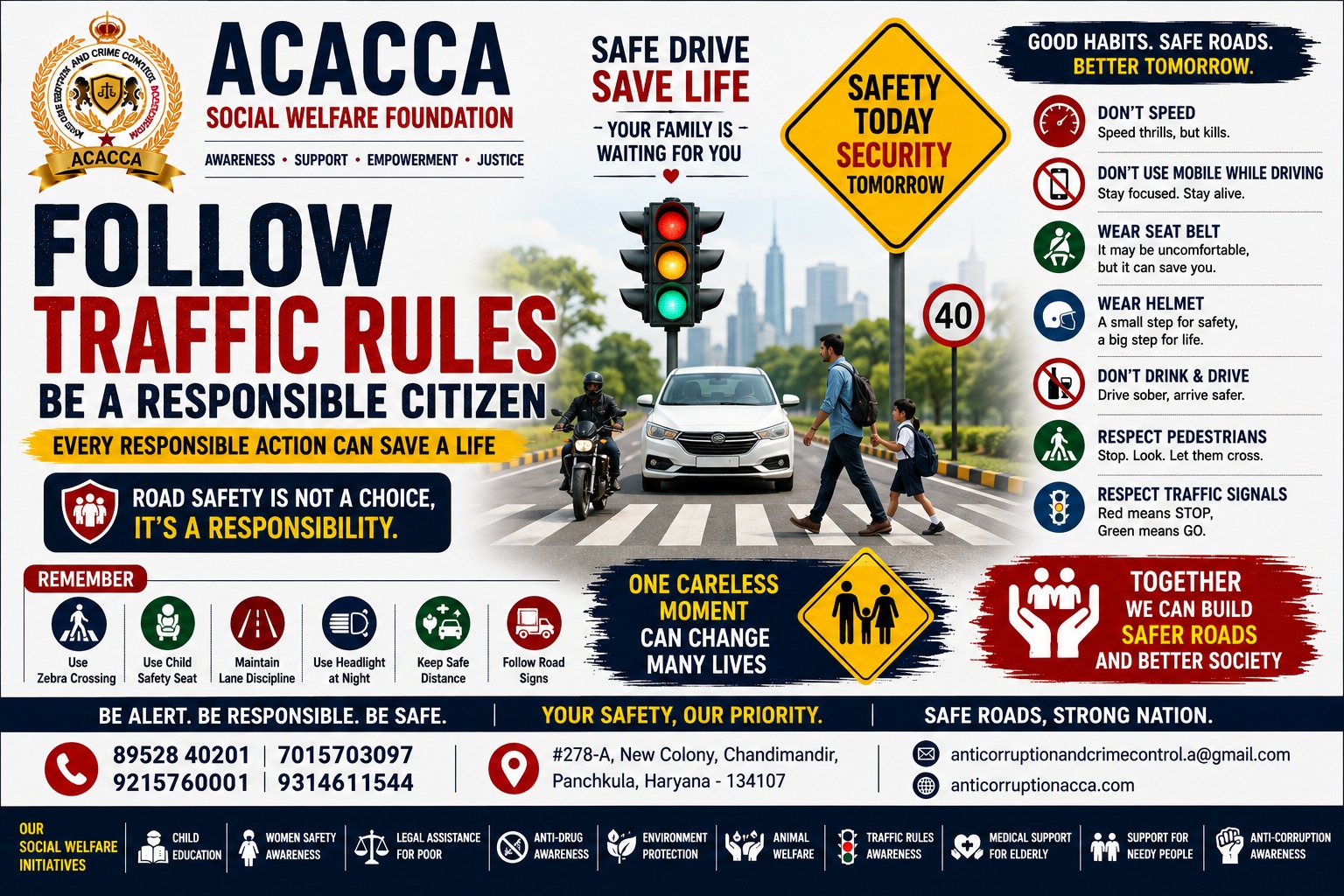
Roads connect people, communities, schools, workplaces, and businesses every day. But every journey also comes with responsibility. Following traffic rules is not simply about avoiding fines. It is about protecting human lives.
Road accidents can happen because of speeding, distracted driving, unsafe overtaking, driving without proper safety equipment, ignoring traffic signals, or careless behavior on the road. Many of these risks can be reduced when people understand and follow basic road-safety practices.
ACACCA Social Welfare Foundation includes traffic rules awareness among its social welfare activities and aims to encourage responsible road behavior and greater public awareness.
Why Traffic Rules Matter
Traffic rules are designed to create an organized and safer environment for everyone using the road.
Drivers, pedestrians, cyclists, two-wheeler riders, passengers, and other road users all share responsibility for road safety.
Following traffic rules can help:
- Reduce avoidable accidents
- Protect pedestrians
- Improve traffic discipline
- Encourage responsible driving
- Reduce dangerous road behavior
- Protect children and elderly pedestrians
- Create safer roads for everyone
A few seconds of patience can sometimes prevent a serious accident.
Road Safety Is Everyone’s Responsibility
Road safety should not be considered only a driver’s responsibility.
A pedestrian crossing the road, a cyclist travelling through traffic, a passenger wearing a seat belt, and a two-wheeler rider wearing a helmet are all participating in road safety.
Every road user has a role to play.
Responsible behavior becomes especially important in busy areas such as markets, schools, residential communities, highways, and intersections.
Follow Traffic Signals and Signs
Traffic signals and road signs provide important information to road users.
Ignoring a red light, entering a restricted area, or failing to follow warning signs can put multiple people at risk.
Drivers should remain attentive to signals, signs, road markings, and changing traffic conditions.
Pedestrians should also use designated crossings and follow signals wherever available.
Avoid Speeding
Speed is one of the most important factors affecting road safety.
Driving faster than appropriate for the road and traffic conditions can reduce reaction time and increase the severity of a collision.
Responsible drivers should follow applicable speed limits and adjust their speed according to weather, visibility, road conditions, traffic density, and the presence of pedestrians.
Do Not Drive Under the Influence
Driving after consuming alcohol or other impairing substances can seriously affect judgment, reaction time, coordination, and decision-making.
A person who is impaired should not drive.
The safest choice is to arrange an alternative mode of transportation and ensure that an impaired person does not operate a vehicle.
Avoid Distracted Driving
A driver needs full attention on the road.
Using a mobile phone while driving, looking away from traffic, adjusting devices repeatedly, or engaging in other distracting activities can reduce concentration.
Drivers should keep their attention on the road and deal with non-essential tasks only after reaching a safe location.
Helmets and Seat Belts Save Lives
Basic safety equipment is an important part of responsible road use.
Two-wheeler riders should use properly fitted helmets as required by applicable rules. Vehicle occupants should use seat belts where required.
These simple safety measures can provide important protection in the event of a crash.
Protecting Children and Elderly Pedestrians
Children and elderly people may require additional care while navigating busy roads.
Drivers should remain alert around:
- Schools
- Residential areas
- Markets
- Hospitals
- Parks
- Pedestrian crossings
Reducing speed and staying attentive in areas with vulnerable road users can make roads safer for everyone.
Pedestrian Safety Matters Too
Pedestrians also have an important role in road safety.
Where available, pedestrians should use designated crossings, follow traffic signals, remain alert around moving vehicles, and avoid suddenly entering traffic.
At night or in low-visibility conditions, extra caution is particularly important.
Responsible Two-Wheeler Riding
Two-wheelers are widely used for daily travel, but riders are also exposed to greater risk during collisions.
Responsible riders should:
- Wear a properly fitted helmet
- Follow traffic signals
- Maintain a safe speed
- Avoid dangerous overtaking
- Stay attentive to surrounding traffic
- Avoid using a mobile phone while riding
- Never ride while impaired
Passengers should also follow applicable safety requirements.
The Role of Public Awareness
Rules alone cannot create safe roads. People need to understand why those rules exist.
Public awareness programs can help communities understand the consequences of unsafe road behavior and encourage better habits.
This is where social welfare organizations can make a useful contribution.
ACACCA Social Welfare Foundation aims to create awareness about traffic rules with the support and cooperation of the police administration.
The Role of NGOs in Road Safety Awareness
Social organizations can help spread road-safety messages at the community level.
Their efforts can include:
- Organizing public awareness campaigns.
- Educating citizens about basic traffic rules.
- Encouraging responsible driving habits.
- Promoting awareness around schools and public areas.
- Supporting cooperation with relevant authorities.
- Encouraging pedestrians and drivers to respect one another.
- Sharing reliable road-safety information.
Awareness initiatives can complement the work of traffic and law-enforcement authorities.
Teaching Road Safety to Children
Road-safety education should begin early.
Children can be taught basic habits such as:
- Using designated pedestrian crossings
- Waiting for appropriate signals
- Looking carefully before crossing
- Staying away from moving vehicles
- Wearing appropriate safety equipment when travelling
- Listening to responsible adults while near roads
Teaching children these habits can help them become safer road users as they grow older.
What Responsible Drivers Can Do
A responsible driver should think beyond their own safety.
Before starting a journey, drivers can make sure they are alert, their vehicle is in appropriate condition, and they understand the route.
While driving, they should remain attentive, follow applicable rules, maintain a safe distance, and avoid unnecessary risks.
Good driving is not about reaching the destination as quickly as possible. It is about reaching safely.
What Every Citizen Can Do
Road safety requires collective participation.
Citizens can:
- Follow traffic rules consistently.
- Avoid dangerous driving behavior.
- Use helmets and seat belts appropriately.
- Avoid distracted or impaired driving.
- Respect pedestrians and cyclists.
- Follow traffic signals.
- Encourage children to learn road-safety habits.
- Cooperate with traffic authorities.
- Spread responsible road-safety information.
When these habits become normal within a community, road safety can improve.
Road Safety and Social Welfare
Road safety is directly connected to social welfare because road accidents can affect families, education, employment, healthcare, and financial stability.
A serious accident can create physical, emotional, and economic difficulties for an entire family.
Preventive awareness is therefore an important part of building safer communities.
ACACCA Social Welfare Foundation’s Broader Mission
Traffic rules awareness is one part of ACACCA Social Welfare Foundation’s wider social welfare work.
The foundation also focuses on:
- Child education
- Women safety awareness
- Legal assistance for poor people
- Anti-drug awareness
- Environmental protection
- Animal welfare
- Medical support for elderly people
- Support for poor and needy people
- Public awareness programs
- Emergency assistance
- Anti-corruption awareness
These initiatives focus on different aspects of community wellbeing and responsible citizenship.
Building a Safer Road Culture
A safer road culture begins when people stop viewing traffic rules as optional.
Every driver who slows down near a school, every rider who wears a helmet, every passenger who uses a seat belt, and every pedestrian who follows a safe crossing practice contributes to a safer community.
The goal should not simply be to avoid penalties. The goal should be to protect lives.
Conclusion
Road safety is a shared responsibility. Traffic rules exist to protect everyone, and following them is one of the simplest ways citizens can contribute to community welfare.
Through public awareness, responsible driving, pedestrian safety, proper use of safety equipment, and cooperation with authorities, communities can work toward safer roads.
ACACCA Social Welfare Foundation supports traffic rules awareness as part of its commitment to social welfare and public awareness.
Follow the rules. Stay alert. Respect every road user. Help make every journey safer.
Contact ACACCA Social Welfare Foundation
Registered Office:
#278-A, New Colony, Chandimandir, Panchkula, Haryana – 134107
Website: anticorruptionacca.com
Email: anticorruptionandcrimecontrol.a@gmail.com
Contact Numbers:
89528 40201 | 7015703097 | 9215760001 | 9314611544